
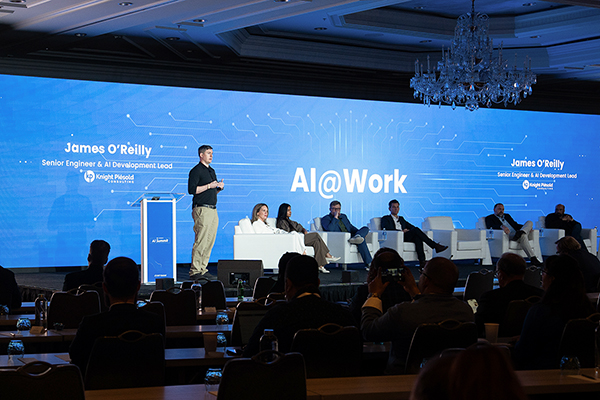
James O'Reilly Shares Knight Piésold's Approach to AI in Engineering at BST Global's 2026 AI Summit
November 26, 2026, Vancouver, BC, Canada – James O’Reilly, Senior Engineer and AI Development Lead at Knight Piésold Canada, recently spoke about how the company uses AI while keeping engineers accountable for the results. He presented at BST Global’s 2026 AI Summit, held November 10–12, in Palm Beach, Florida.
This was the third AI Summit that BST Global hosted for the architecture, engineering, and construction (AEC) industry. It brought together leaders from top AEC companies to discuss how they are becoming AI-enabled, data-driven organizations.
O’Reilly presented “Practitioner-Built AI” in the AI@Work Showcase, a session that BST Global created for the first time this year to feature the most innovative AI projects in AEC. Other presentations came from Ardurra, Egis, Spiire, and Verdantas. Together, the talks showed how AI is delivering practical value for AEC companies and their clients in project delivery, in operations, and in the field.
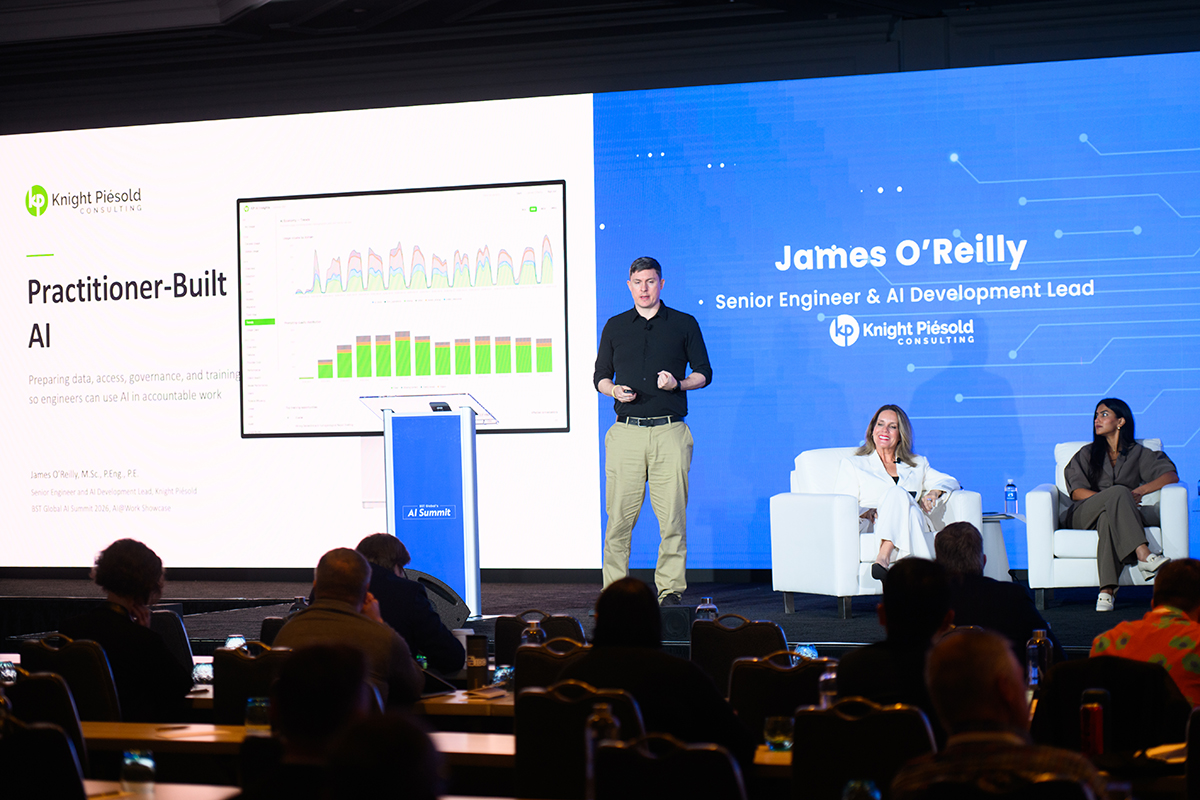
Knight Piésold builds and runs its own AI platform, which serves more than 1,500 team members across 30 offices in 16 countries. O’Reilly leads the AI Development Team and uses the platform in his own hydropower engineering practice.
His presentation began with Knight Piésold’s approach to building a platform centred on accountable engineering. Because engineering errors carry legal liability, the platform was designed around verification. Under that approach, the AI Development Team builds the infrastructure, data connections, access controls, governance, training, and measurement, while engineers bring their own methods, ideas, and solutions, and own the results.
He then showed the platform in use. KP AI, the company’s in-house chat interface, draws on Knight Piésold’s own records and technical library, with every response citing its sources. In one case study, O’Reilly built a quality screening matrix to guide a multi-pass, AI-assisted review of a 15-document pumped storage design report. The review screened the report against 500 of the owner’s requirements and used separate passes to check consistency across documents, cross-references, calculation accuracy, and writing style. Once configured, the screening took roughly an hour, compared with O’Reilly’s estimate of several weeks of senior engineering time for an equivalent manual screening. Discipline leads then reviewed the findings and made the changes.
Turning to measurement, O’Reilly explained how the AI Development Team tracks use, quality, performance, and cost across the platform, and how that data shapes training and next priorities. He concluded that as models improve, companies can still control their data, access, governance, and education. Of these, he said, education matters most, and the most important skill within it is clear communication.
“A senior engineer I worked with early in my career told me: ‘Your engineering is only ever as good as your ability to communicate it,’” said O’Reilly. “I think that’s more relevant than ever.”
“Our clients rely on a professional engineer’s signature, so we have to communicate clearly how we perform our analyses and how they are checked,” he added.
That commitment shapes how Knight Piésold uses AI for clients. The platform was built by engineers, for engineers, and is a core tool for refining engineering analysis, optimizing designs, and improving project outcomes. It also gives the team new ways to draw on the company’s knowledge and project data. As the technology evolves, Knight Piésold will keep adapting it to remain at the forefront, developing practical solutions to complex engineering challenges.

Photos courtesy of BST Global.